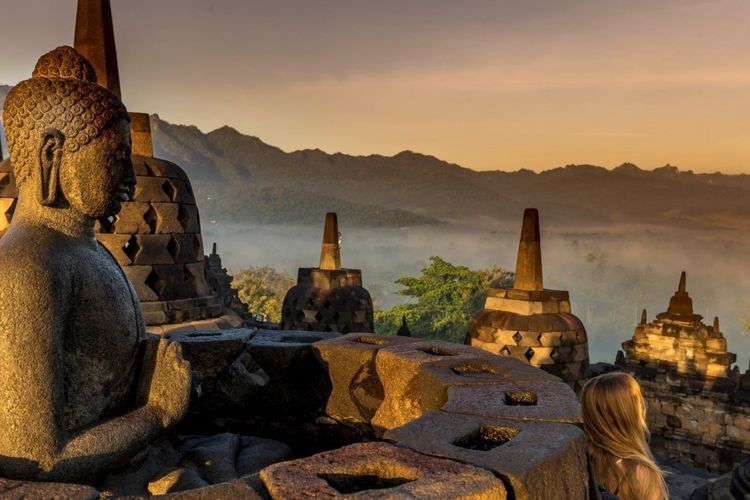
There are many Borobudur Temple interesting facts that make this ancient monument worth exploring beyond its famous silhouette. Borobudur combines Buddhist symbolism, detailed stone carvings, geometric architecture, and centuries of history. Looking closely at its different sections can reveal fascinating details about the monument and the people who created it.
Borobudur Uses a Unique Architectural Layout
One of the most interesting features of Borobudur is its unusual combination of square and circular sections. The lower levels contain square terraces and galleries, while the upper levels consist of circular platforms.
This arrangement creates a noticeable change as visitors climb toward the summit. The lower areas feature detailed carvings and statues, while the upper platforms provide a more open architectural setting.
The central stupa completes this carefully organized design.
Thousands of Reliefs Cover the Monument
Another important Borobudur Temple interesting fact is the enormous amount of stone artwork found throughout the galleries.
The reliefs depict Buddhist stories, human activities, animals, buildings, plants, transportation, and other scenes. Artists carved these images directly into the stone walls.
Because visitors encounter the reliefs while walking through the galleries, the artwork becomes part of the overall journey through the monument.
Buddha Statues Appear in Different Locations
Buddha statues are positioned throughout several sections of Borobudur. Many sit inside niches along the square terraces, while others appear inside the perforated stupas on the circular platforms.
Their repeated placement creates a strong visual pattern throughout the monument.
The statues also display different hand gestures, known as mudras, which carry symbolic meanings within Buddhist traditions.
For travelers who want to learn more about Borobudur’s history, architecture, Buddhist meaning, and interesting details, this Borobudur facts guide provides additional information.
The Upper Stupas Create Changing Views
The upper circular platforms contain rows of perforated stupas. Their stone openings create a distinctive lattice-like appearance.
As visitors walk around the platforms, the Buddha statues inside can appear differently from each angle. Sometimes the figures are clearly visible, while the stone lattice partially hides them from other positions.
This makes the upper section particularly interesting for visitors who enjoy observing architectural details.
Borobudur Reflects Buddhist Cosmology
Borobudur’s architectural levels are traditionally connected with Buddhist cosmological ideas. The different sections create a progression from the lower terraces toward the summit.
The changing architectural forms support this interpretation. Detailed galleries dominate the lower levels, while the upper platforms emphasize stupas and open space.
The design therefore combines physical movement with religious symbolism.
Ancient Builders Used Volcanic Stone
The monument was constructed mainly from volcanic stone, which ancient craftsmen shaped and arranged into the terraces, walls, stairways, and other architectural components.
Creating such a large structure required careful organization and skilled workmanship.
The stone also provided surfaces for the detailed reliefs that remain one of Borobudur’s most recognizable artistic features.
Borobudur Has Experienced Centuries of Change
Another fascinating fact is the monument’s long historical journey. Borobudur experienced periods of decline and neglect before gaining renewed attention in modern times.
Natural conditions affected parts of the structure over the centuries, making restoration and conservation important.
Modern preservation work has helped protect the monument’s architecture and artwork for future generations.
Why Borobudur Remains Fascinating
These Borobudur Temple interesting facts demonstrate that the monument offers much more than an impressive photograph. Its architecture, reliefs, Buddha statues, stupas, and Buddhist symbolism work together to create a complex historical site.
Travelers who want to visit Borobudur and other destinations around Central Java can also explore Borobudur Tours.
Taking time to observe the smaller details can make a visit more rewarding. Each terrace, relief, statue, and stupa contributes to the story of an ancient monument that continues to connect visitors with Java’s cultural heritage.