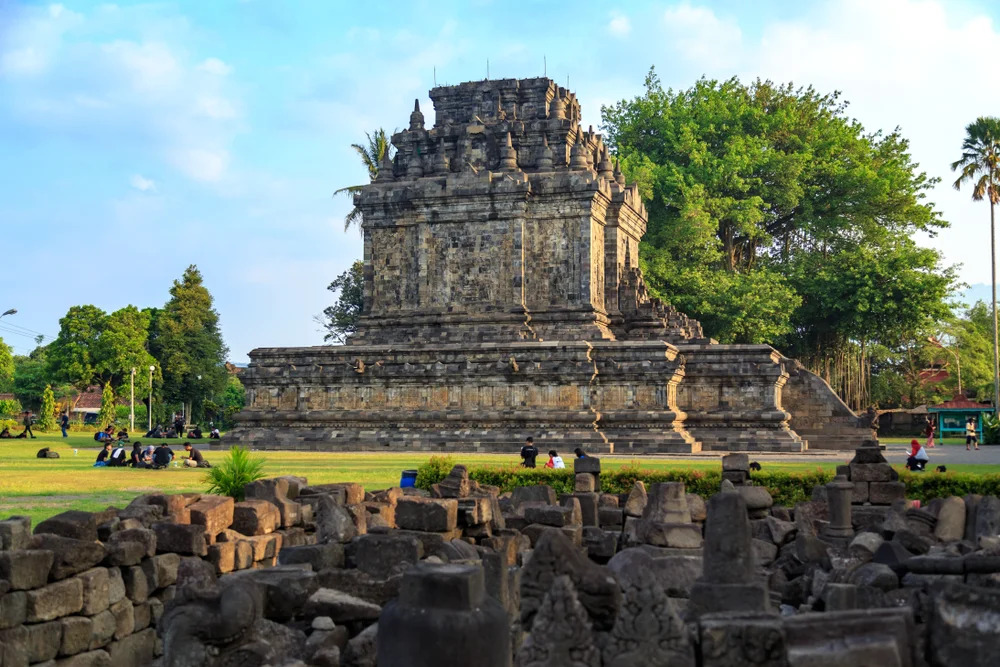
The Borobudur Mendut Pawon Temples create an important Buddhist heritage route in Central Java. Most travelers know Borobudur because of its monumental size and famous stupas. However, Mendut and Pawon also play an important role in the wider historical landscape. Visiting all three gives travelers a better understanding of Buddhist culture in the region.
How Are the Three Temples Connected?
Borobudur, Pawon, and Mendut stand along a similar east-west line. Borobudur lies at the western end, while Pawon sits between Borobudur and Mendut.
UNESCO recognizes the three monuments together as the Borobudur Temple Compounds. Their relationship goes beyond location. UNESCO also connects the monuments with different stages in the Buddhist journey toward Nirvana.
This connection makes the route especially interesting for travelers who enjoy history, religion, and architecture.
For more context about the largest monument, read our guide to Borobudur Temple history and facts. It explains Borobudur’s architecture, symbolism, reliefs, and Buddhist meaning.
Borobudur: The Main Spiritual Monument
Borobudur stands as the largest and most complex site on the route. Its design includes a broad base, five square terraces, three circular platforms, and a central stupa.
Visitors can walk through galleries filled with reliefs and Buddha images. The upper terraces feature 72 openwork stupas around the central structure.
Its architecture reflects Buddhist cosmology. Each level guides visitors through a symbolic journey from worldly desire toward the formless realm.
Allow the most time for Borobudur because the monument contains many architectural and artistic details.
Mendut: A Sacred Interior Space
Mendut offers a very different experience. Instead of wide terraces, the temple has an enclosed inner chamber.
Inside, visitors can see a large seated Buddha accompanied by two Bodhisattvas. These statues give Mendut a strong religious atmosphere.
The temple remains important during Buddhist ceremonies and pilgrimages. Its smaller size also makes it easy to explore after visiting Borobudur.
Spend time looking at the stone carvings around the structure. They add another layer of artistic detail to the visit.
Pawon: The Link Between Two Temples
Pawon stands between Borobudur and Mendut. Its smaller structure creates a quick but meaningful stop.
The temple contains decorative carvings and a compact interior. Historians still debate the original object of worship inside Pawon. However, its position supports the close relationship between the three Buddhist monuments.
Travelers can usually explore Pawon without needing much time. This makes it easy to include in the same itinerary.
How to Visit All Three
A simple route can begin at Borobudur, continue to Pawon, and finish at Mendut. This order follows their geographic position and keeps transport straightforward.
Travelers from Yogyakarta can arrange a private Borobudur tour for easier transportation and itinerary planning. Private transport also gives you more flexibility for adding nearby villages, sunrise viewpoints, or other attractions.
Keep most of your sightseeing time for Borobudur. Pawon and Mendut require shorter visits.
Why Visit the Complete Temple Route?
Seeing all three monuments helps travelers understand the Buddhist landscape beyond Borobudur alone. Each temple presents a different architectural style and atmosphere.
Borobudur offers scale and symbolism. Pawon provides an important connecting point, while Mendut creates a more intimate sacred setting.
Conclusion
The Borobudur Mendut Pawon Temples form a meaningful Buddhist heritage route in Central Java. Together, they reveal different aspects of architecture, worship, history, and spiritual symbolism.
Visiting all three creates a deeper experience than exploring Borobudur alone. With a simple itinerary, travelers can discover how these monuments connect within one remarkable cultural landscape.